

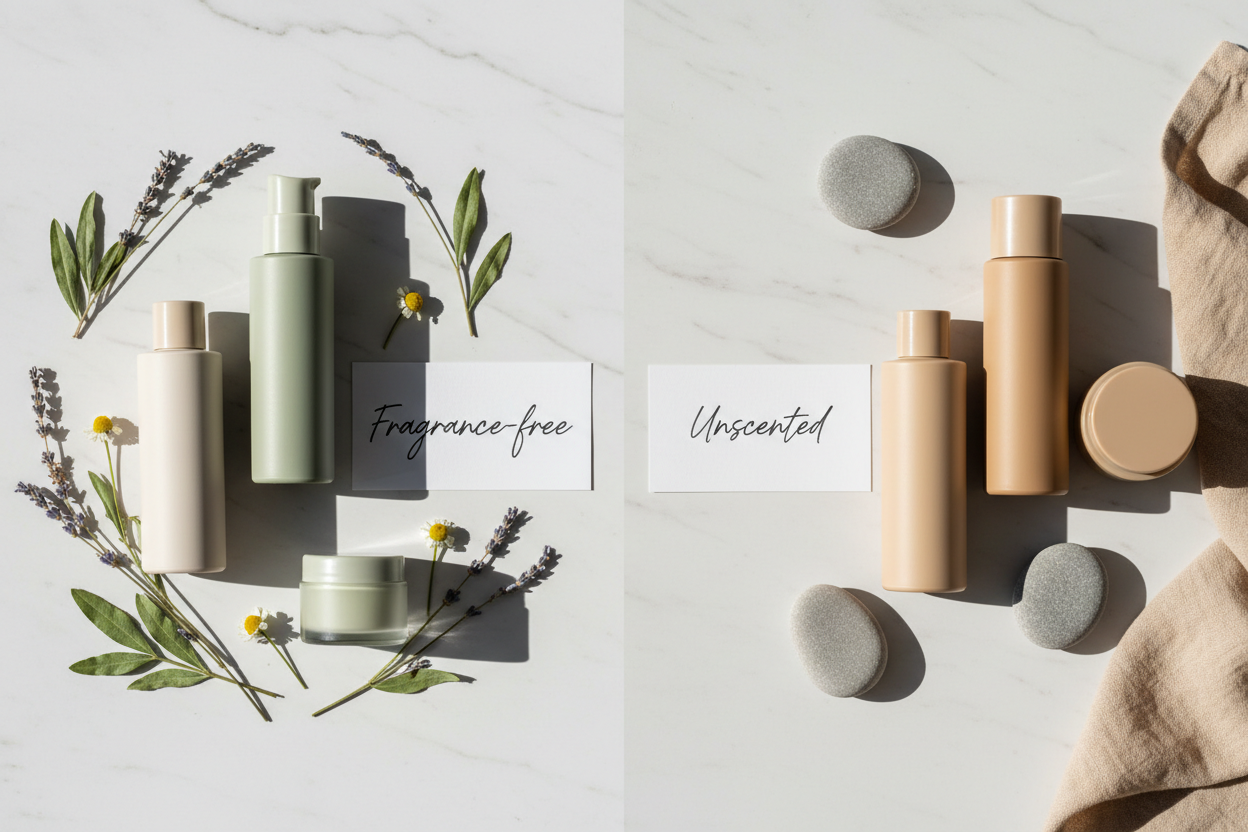
Here's a piece of labelling trivia that surprises almost everyone: an "unscented" product can legally contain fragrance.
If your skin is easily irritated and you've been diligently buying unscented products while your skin keeps objecting, this article may explain why.
Two words, two very different meanings
Fragrance-free means no fragrance materials have been added to the formula, either to create a scent or to hide one.
Unscented means the product has no perceptible smell. That's a statement about your nose, not about the ingredient list. Raw cosmetic ingredients often have natural odours — plant oils and extracts frequently smell distinctly "ingredient-y" — and one way to deal with that is to add a small amount of masking fragrance that neutralises the smell. The product smells like nothing. It is not free of fragrance.
For most people this distinction is academic. For people whose skin reacts to fragrance components, it's the difference between a product that works and a product that stings.
Why fragrance is the ingredient to watch
Fragrance consistently ranks among the most common causes of cosmetic-related skin reactions, and it's easy to understand why. A single "parfum" entry on a label can represent a blend of dozens of individual aroma compounds, none of which must be listed separately in most cases. That's a lot of unnamed variables to apply to reactive skin, in exchange for a function that is entirely aesthetic. Fragrance makes a product nicer to smell. It does nothing for your skin.
This is also true of natural fragrance. Fragrant essential oils — lavender, citrus oils, peppermint, eucalyptus, tea tree — are complex mixtures of aroma compounds, and several of their components are well-documented sensitisers. "Naturally scented" is still scented.
An important distinction while we're here: an essential oil is not the same thing as a botanical extract. Essential oils are the concentrated aromatic fraction of a plant — the smell, distilled. Extracts like aloe leaf gel, calendula, cucumber or chamomile extract capture other components of the plant and are among the best-tolerated ingredients in skincare. This is why a formula can be genuinely botanical and still be a sensible choice for reactive skin: what matters is which part of the plant, and what the evidence says about it.
Where fragrance hides on a label
When you scan an ingredient list, look for:
- Parfum / Fragrance / Aroma — the catch-all terms
- Fragrant essential oils — aromatic plant oils such as lavandula angustifolia oil, citrus limon peel oil, mentha piperita oil
- Individual aroma compounds — linalool, limonene, citronellol, geraniol, eugenol and similar names, which sometimes appear separately
- "Natural fragrance" or "botanical blend" — fragrance with better PR
If none of these appear anywhere on the list, you're looking at a product without added fragrance.
"But my skin isn't allergic to fragrance"
You may be right, and if scented products have never bothered you, there's no need to fear them. But if your skin is currently reactive, or you've never been able to pin down what it's reacting to, removing added fragrance is the single highest-yield simplification you can make. It eliminates dozens of potential irritants in one decision, at zero cost to how well your skincare works.
Think of it as controlling variables, which is exactly what it is. When we formulate, we leave fragrance out for the same reason a careful experiment doesn't add unnecessary steps: every addition is a potential confounder.
The εὖSKIN position
εὖSKIN formulas are made without synthetic fragrance and without essential oils — it's a standing exclusion in our formulation rules, alongside drying alcohols, parabens, sulphates, mineral oil and formaldehyde-releasers. Our products carry the gentle natural character of their raw ingredients — plant oils and botanical extracts chosen for tolerance, every one listed and referenced on our Ingredients page — rather than a perfume designed to disguise them. We'd rather a product smell like what it is than add an ingredient whose only job is theatre.
If you're doing a fragrance elimination trial — a few weeks using only products without added fragrance to see how your skin responds — the εὖSKIN three-step routine is a clean baseline to run it with.


